Dura Europos Exhibit
Without doubt, the highlight of my two years at Yale was the opportunity to organize an art exhibit dedicated to the most ancient synagogue in the world. The story of its discovery, during WWI, is worthy of Indiana Jones. The site, an ancient caravan city connecting the Roman and the Persian (Iranian) empires, was excavated extensively by French and American archaeologists. The city, known as Dura-Europos, boasted temples dedicated to a variety of gods, army barracks, public monuments and private homes, a Christian baptistry and a Jewish synagogue.
The walls of the synagogue were covered with colorful paintings featuring biblical figures and scenes (in defiance of the second commandment of “no graven images”).[1] If you visited the synagogue in its heyday, about 1700 years ago, you could have feasted your eyes on the marching Hebrews out of Egypt (the Exodus), and even on baby Moses in the floating ark, at the very moment when the Egyptian princess saved him.
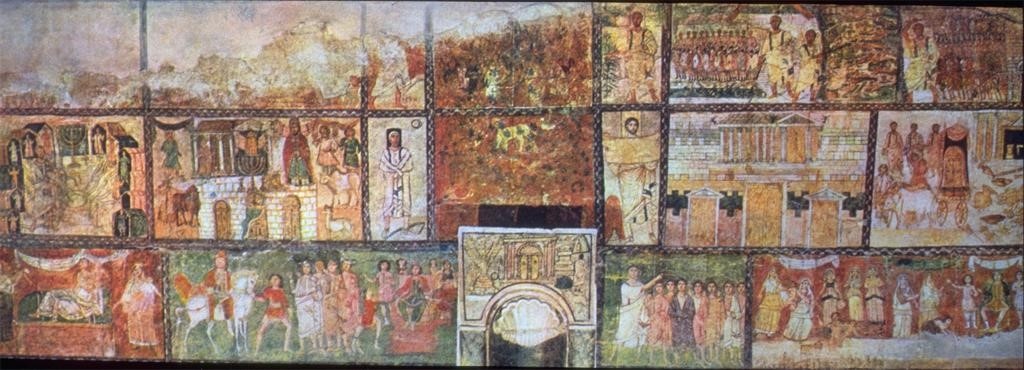
Retelling the Story of Moses at Dura Europos Synagogue
These were two of the many painted panels that enriched this unique space.
The originals were transferred to the national museum in Damascus (Syria) where they presumably still reside.[2] Full scale copies were deposited at Yale University Art Gallery. With the warm support of New Haven Jewish community and gracious permission from the Gallery, I was able to organize an art exhibit that recreated the synagogue’s main hall of prayer with its paintings.
A period of intensive preparations was followed by the opening night of the exhibit at the Jewish Community Center in New Haven. I invite you to share the moment (invitation enclosed) as well as to read the article about the exhibit, published in the New York Time (a month after the opening, just in time for flood of visitors just before closing). Among the latter were Joseph and Ann Turnbach who became lifelong friends. Their own art collection was bequeathed to the arts museum at Queens College, New York City.
I am enclosing the NYT article, both the original and the digitized version, the latter full of typos.
The following is a link to the Ternbach Collection at Queen College, NYC.
For anyone interested in this unique monument, I am enclosing the guidebook to the exhibit, printed (as I distinctly recall) during several nights in a local printing house and distributed free of charge to all visitors. Since then, many publications have been devoted to the Dura Europos synagogue, including my own analysis of children in the Dura synagogue in Sivan, Jewish Childhood in the Roman World. My modest 1978 guidebook is a good start.
[1] The Synagogue of Dura-Europos: Art, Identity, and Faith on the Euphrates Excellent photos and map of the city.
[2] The National Museum in Damascus: Journey Through Past for a beautifully illustrated overview of the museum.